I recently read Atlas Shrugged with a group of friends and coworkers. We met every week to discuss a chapter. It took thirty weeks to complete, but the time was well-spent. Ayn Rand’s worldview challenged my fundamental beliefs and studying her book added a new dimension to my understanding of the world. The next book that our group read was Flatland by Edwin Abbott, and this book was a good contrast to Ayn Rand’s approach to knowledge. Ayn Rand was supremely confident in the ability of human reason to arrive at objective truth. Flatland takes the reader on a geometrical journey that causes him to consider that Rand’s confidence may not be warranted. The following paragraphs highlight some thoughts I had while reading Flatland in the shadow of Atlas Shrugged.
In engineering, defining your frame of reference is essential. Position, velocity, and acceleration are just a few examples of parameters that can only be understood with respect to a frame of reference. Even the simple concept of “up” can be confusing. To the bridge engineer, “up” is defined as the direction that opposes gravity. To the aeronautical engineer, “up” is the direction up from the wings (and wings aren’t always level). Neither concept of “up” is wrong—it’s simply a matter of knowing the frame of reference. When attempting to understand a concept, it is important to understand the frame of reference in which that concept was formed. It’s easy to assume that others share our perspective and therefore should come to the same conclusion. This, however, is not always the case. Different perspectives can lead to two different conclusions that are both logical when understood in light of the underlying perspective.
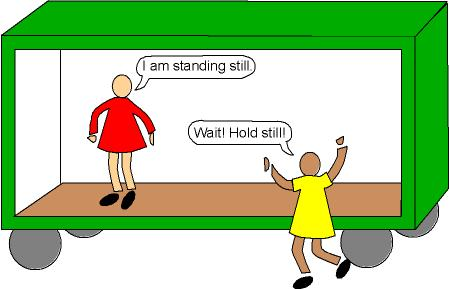
Our limited perspective limits our knowledge. If there are perspectives that we don’t understand, then there are truths that we cannot comprehend. It takes humility to accept this inescapable frailty. We cannot know everything, but knowing this will give us a leg up. Remember that “the fear of the LORD is the beginning of knowledge” (Proverbs 1:7). Understanding our relationship to Knowledge will help us maintain a perspective conducive to understanding new concepts.
My favorite part of Flatland occurs when the narrator (a square who resides in Flatland) visits a new country—the country of Pointland. Pointland is a zero dimensional space. It’s sole occupant, a point, has no concept of two. Listen to the point talking to himself in the excerpt below.
“Infinite beatitude of existence! It is; and there is none else beside it. It fills all Space, and what It fills, It is. What It thinks, that It utters; and what It utters, that It hears; and It itself is Thinker, Utterer, Hearer, Thought, Word, Audition; it is the One, and yet the All in All. Ah, the happiness, ah, the happiness of Being!”
As laughable as this monologue is, it actually makes sense when understood from the point’s perspective. All that he said is true from the perspective of his zero dimensional space. What he didn’t understand was that there were other dimensions. From the perspective of Lineland, Pointland, or Spaceland, the little creature sounds like an arrogant fool. How many times do we find ourselves behaving like the point? We Spacelanders looking down in pity upon Flatland is analogous to the narrator looking down in pity upon Pointland. Like the narrator, we tend to see our existence as the fullness of reality and everyone else as miserable and ignorant fools with limited comprehension. Can we be more open minded like the narrator’s hexagonal grandson and look for meaning in 33? There might be another dimension that we cannot grasp. It is difficult to understand the world apart from our experiences of it. Our reason has limits and we need to be aware of this. Be humble in your knowledge–there is always more to learn.

 Thomas Rainey
That was an enjoyable read. I liked the graphic illustration
LikeLiked by 1 person