#5 Introduction to Logic

I’ve been interested in logic for years, but have never taken the initiative to learn anything about the subject. Clark, my brother, suggested we go through a course on logic together as a remedy for our ignorance. As we journey through this course, I will post updates about what I’ve learned. The following notes are based off of the Critical Thinking lecture series presented by Dr. Greg Bahnsen.

LECTURE 1

Logic is the study of arguments. But what exactly is an argument?
What is an argument?

An argument can be defined as a group of propositions where the truth of one is asserted on the basis of the evidence furnished by the others. Said more simply, an argument is a sequence of connected propositions that work together to support the truth of the ultimate proposition. The supporting propositions are known as the premises of the argument. The ultimate or final proposition (the point of the argument) is known as the conclusion.

Propositions, though, need to be more properly understood. A proposition is what a sentence asserts. It is either true or false. Questions and commands are not propositions.

Propositions are either true or false.

A proposition is not unique to a specific sentence written in a specific language. Rather, a proposition is what that sentence asserts–it is the declarative sentence’s meaning. Thus, the same proposition can be expressed in a multitude of ways. Consider the following proposition: “In steady flight, an airplane’s lift is equal to its weight.” I could state the same proposition using a different sentence. For example: “An airplane’s weight is equal to its lift during steady flight.” The material sentences are different, but the immaterial proposition is the same. Aside: The existence of propositions is an importance concept in metaphysics. Metaphysics studies the nature of reality. Materialists believe that nothing immaterial exists. How can the existence of necessary abstract concepts like propositions logically abide in the materialist universe?

With this basic understanding of what propositions are and how they are used in arguments, it is now possible to introduce additional concepts that are used in the study of deductive arguments. An argument is said to be deductively valid when the conclusion cannot be false if the premises are true.

Validity: if the premises are true, then the conclusion cannot be false.

Stated differently, a valid argument has a conclusion that necessarily follows from the premises. A valid argument does not mean that the conclusion is true. It simply means the conclusion is true if the premises are true. To make this distinction clear, I’ve provided some examples below.

Example 1. Valid argument with a false conclusion.

Objects that are heavier than air cannot fly. Airplanes are heavier than air. Therefore, airplanes cannot fly.

Example 2. Valid argument with a true conclusion.

Airplanes can fly. A Cessna 182 is an airplane. Therefore, a Cessna 182 can fly.

Example 3. Invalid argument with a false conclusion.

Roses are red. Violets are blue. Therefore, Thomas is a woman.

Example 4. Invalid argument with a true conclusion.

Roses are red. Violets are blue. Therefore, Thomas is a man.

From the examples above, it is evident that both valid and invalid arguments can have either true or false conclusions. Validity’s only concern is whether the conclusion follows from the premises–not if the premises are true. Keep in mind that the concept of validity only applies to deductive arguments. Inductive arguments cannot be characterized using the concept of validity. The truth of the premises of an inductive argument does not necessitate the truth of the conclusion. The premises merely give some probability about the truth of the conclusion. With better information from the premises, the amount of uncertainty can be reduced, but never eliminated.

One more concept is needed to fully characterize an argument. This is the concept of soundness. An argument is sound if the premises are true and the argument is valid. Based on this definition, we know that sound arguments have true conclusions. I’ll use the tools of logic learned thus far to provide a sound argument in support of the statement that sound arguments have true conclusions.

Valid arguments cannot have false conclusions if the premises are true.

Sound arguments are valid arguments with true premises.

Therefore, a sound argument has a true conclusion.

In summary, logic is the study of arguments. An argument consists of related premises that drive towards a conclusion. Both premises and conclusions are propositions and all propositions are either true or false. An argument is valid when its conclusion cannot be false if the premises are true. An argument is either valid or invalid–not true or false. An argument is sound if the argument is valid and the premises are true. Sound argument always have true conclusions.

#4 The Beginning of Knowledge

I recently read Atlas Shrugged with a group of friends and coworkers. We met every week to discuss a chapter. It took thirty weeks to complete, but the time was well-spent. Ayn Rand’s worldview challenged my fundamental beliefs and studying her book added a new dimension to my understanding of the world. The next book that our group read was Flatland by Edwin Abbott, and this book was a good contrast to Ayn Rand’s approach to knowledge. Ayn Rand was supremely confident in the ability of human reason to arrive at objective truth. Flatland takes the reader on a geometrical journey that causes him to consider that Rand’s confidence may not be warranted. The following paragraphs highlight some thoughts I had while reading Flatland in the shadow of Atlas Shrugged.

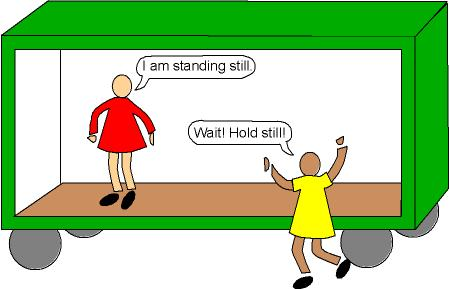
In engineering, defining your frame of reference is essential. Position, velocity, and acceleration are just a few examples of parameters that can only be understood with respect to a frame of reference. Even the simple concept of “up” can be confusing. To the bridge engineer, “up” is defined as the direction that opposes gravity. To the aeronautical engineer, “up” is the direction up from the wings (and wings aren’t always level). Neither concept of “up” is wrong—it’s simply a matter of knowing the frame of reference. When attempting to understand a concept, it is important to understand the frame of reference in which that concept was formed. It’s easy to assume that others share our perspective and therefore should come to the same conclusion. This, however, is not always the case. Different perspectives can lead to two different conclusions that are both logical when understood in light of the underlying perspective.

Frames of reference and types: A relativistic approach | by Suyash Dubey |  Medium

Our limited perspective limits our knowledge. If there are perspectives that we don’t understand, then there are truths that we cannot comprehend. It takes humility to accept this inescapable frailty. We cannot know everything, but knowing this will give us a leg up. Remember that “the fear of the LORD is the beginning of knowledge” (Proverbs 1:7). Understanding our relationship to Knowledge will help us maintain a perspective conducive to understanding new concepts.

My favorite part of Flatland occurs when the narrator (a square who resides in Flatland) visits a new country—the country of Pointland. Pointland is a zero dimensional space. It’s sole occupant, a point, has no concept of two. Listen to the point talking to himself in the excerpt below.

“Infinite beatitude of existence! It is; and there is none else beside it. It fills all Space, and what It fills, It is. What It thinks, that It utters; and what It utters, that It hears; and It itself is Thinker, Utterer, Hearer, Thought, Word, Audition; it is the One, and yet the All in All. Ah, the happiness, ah, the happiness of Being!”

As laughable as this monologue is, it actually makes sense when understood from the point’s perspective. All that he said is true from the perspective of his zero dimensional space. What he didn’t understand was that there were other dimensions. From the perspective of Lineland, Pointland, or Spaceland, the little creature sounds like an arrogant fool. How many times do we find ourselves behaving like the point? We Spacelanders looking down in pity upon Flatland is analogous to the narrator looking down in pity upon Pointland. Like the narrator, we tend to see our existence as the fullness of reality and everyone else as miserable and ignorant fools with limited comprehension. Can we be more open minded like the narrator’s hexagonal grandson and look for meaning in 33? There might be another dimension that we cannot grasp. It is difficult to understand the world apart from our experiences of it. Our reason has limits and we need to be aware of this. Be humble in your knowledge–there is always more to learn.

#3 What Makes a Soulmate?

Ever since Rowan turned five years old, we have read a chapter of a book each night before bed. The book changes, but the routine remains the same. It is the highlight of my night, and he has come to enjoy it too. This year, we have read probably two thousand pages consisting of The Trumpet of the Swan; The Lion, the Witch, and the Wardrobe; The Call of the Wild; Gulliver’s Travels; The Little Prince; Charlotte’s Web; The Little Pilgrim’s Progress; Stuart Little; Alice’s Adventures in Wonderland; The Adventures of Huckleberry Finn; and right now we are finishing up White Fang. I have been surprised at what I have learned through these children’s books. My favorite so far has been The Little Prince and I’ll summarize the plot below and give some insight into why this book has become special to me.

The narrator is an aircraft pilot who crashes into the Sahara desert far from any other humans. To his shock, he runs into a visitor from another planet–a boy with blonde hair named “the little prince.” Over the next few days in the desert, the little prince recounts his adventures to the narrator who is busily trying to fix his plane. Many topics are covered during their eight days together, but the one that really stuck with me was their conversation on love.

The little prince lived on planet B-612 and on this planet there was only one flower–a rose. This was the most special creation to him because it was the only flower on his planet. He talked to the rose, watered the rose, picked the caterpillars off the rose, and put a glass globe over the rose at night to protect her from the cold wind. His life revolved around making sure his rose was protected and loved. The little prince, while visiting Earth, came upon a rose garden. In this garden were hundreds of roses all as beautiful as the one back on planet B-612. The sudden realization that he had spent an enormous amount of his life’s energy caring for what he now knew to be a common rose depressed him.

Saddened about his rose, the little prince soon comes across a fox who asks for the prince to tame him. The little prince is perplexed why the fox should wish to be tamed by him. The fox then explains that to tame something is to “establish ties.” He goes on to say.

“To me, you are still nothing more than a little boy who is just like a hundred thousand other little boys. And I have no need of you. And you, on your part, have no need of me. To you, I am nothing more than a fox like a hundred thousand other foxes. But if you tame me, then we shall need each other. To me, you will be unique in all the world. To you, I shall be unique in all the world.” 

The little prince and the fox become friends and eventually, as they both knew would happen, the day came that the little prince had to depart. Both the fox and the prince were sorrowful. Before they said their farewell, the fox instructed the prince to “Go and look again at the roses. You will understand now that yours is unique in all the world.” The little prince trudged off, as the fox commanded, to look at the rose garden. At the sight of the hundreds of roses in the garden, the lesson the fox had been teaching him became clear. Looking over the roses, the little prince spoke the following words.

“You are not at all like my rose,” he said. “As yet you are nothing. No one has tamed you, and you have tamed no one. You are like my fox when I first saw him. He was only a fox like a hundred thousand other foxes. But I have made him my friend, and now to me, he is unique in all the world. You are beautiful, but you are empty,” he went on. “One could not die for you. To be sure, an ordinary passer-by would think that my rose looked just like you–the rose that belongs to me. But in herself alone she is more important than all the hundreds of you other roses: because it is she that I have watered; because it is she that I have put under the glass globe; because it is she that I have sheltered behind the screen; because it is for her that I have killed the caterpillars (except for two or three that we saved to become butterflies); because it is she that I have listened to, when she grumbled, or boasted, or even sometimes when she said nothing. Because she is my rose.”

The little prince learned an important lesson that I think we need to consider with respect to the common usage of the term “soulmate.” When I hear people talk about soulmates, it is typically used in the context of a sequence of unlikely events that leads to the pairing of two people who each have found the best, most suitable companion out of all humans on earth. If having a soulmate were synonymous with finding the best match, then I think many people would end up like the little prince when he discovers that he doesn’t have the only rose in the universe. I believe that soulmates are created, not found. A good relationship starts with a good match–I don’t deny that. But once you’ve chosen a good partner, it’s the life that you build together that turns this mate into your soulmate. It’s the activities you’ve done together, the movies you’ve laughed over, the places you’ve been, the joys and the sorrows you’ve shared. It’s the time spent together, the children that you’ve made, loved, and raised. The culmination of your experiences together as a couple bond you in a way that is unique in all the world and that is what makes your partner your soulmate. That is what separates your rose from the garden.

My rose is my soulmate not because she is the only rose. She is my soulmate because “it is she that I have watered; because she is my rose.”

#2 Compromises

An airplane is a flying compromise. Performance gained in one area almost always means a loss of performance in another. Three primary considerations in an aircraft’s design are its speed, cabin room, and fuel burn. You can’t increase one of these aspects of performance without decreasing one of the others. Want your airplane to go a fast but don’t want to increase the fuel burn? Get ready for a cramped cabin! Want to go fast and have plenty of room? Be prepared to burn a lot more fuel. Don’t have the money for all the fuel but still want to be comfortable? I hope you’ve got time, because you are going to be going slow!

The Mooney M20, Beechcraft Bonanza, and Cessna 182 are examples of extremely successful designs that all chose to sacrifice a different aspect of performance. The Mooney sacrificed a spacious cabin, the Bonanza sacrificed a low fuel burn, and the Cessna sacrificed a high cruising speed. In order to create these legendary airframes, each manufacturer went into the design process with the full acknowledgment of the trade-offs built into each one of the thousands of decisions that would become the aircraft.

Living life, in many ways, is like designing an airplane–compromises everywhere! Time, health, and money are three aspects of life where compromises have to be made. Kids usually have time and health, but little money to make their dreams a reality. Middle-aged adults with financially successful careers typically have good health and plenty of money, but insufficient time to enjoy it. When these folks get old, they have time and money, but often don’t have the health to enjoy the experiences that their wealth can afford. The book Die with Zero does an excellent job of pointing out how many of us live our lives without realizing the compromises we are making each day. By ignoring the existence of the compromises inherent in many decisions, we often make sub-optimal life choices. Good life decisions cannot be made without being aware that getting something in one area often means losing something in another. If the aircraft engineer didn’t understand this, his design would not have a clear purpose. It would not have the right compromises necessary to create the desired end product. Our lives, like the airplane, will lack purpose if we make decisions without understanding the underlying compromises. Let’s not fall into the trap of drifting through life. Rather, let’s choose to live by making the tough decisions necessary to create a life evident of purpose.

#1 “Follow the Science…” What did you just say?

I don’t think I’ve heard a phrase more abused than “follow the science.” As COVID-19 and its related policies ravage the world, many disillusioned people give the unsolicited advice to “follow the science.” I ignore the advice because it’s rooted in ignorance.

“Follow the science” is a meaningless phrase. It is meaningless because science is descriptive, not prescriptive. Science can tell you that smoking cigarettes has negative effects on your cardiovascular health. Science cannot tell you that you should not smoke. The decision to smoke or not to smoke requires a value judgment. How much do you value your physical health? How much do you value taking a drag off of a cigarette? How bad does it feel to stop smoking? What is your current physical health? How old are you? Do you enjoy smoking with your friends? What is your occupation? How much money do you make? Two people could have perfect agreement with the scientific conclusion that smoking is bad for your health. Those same two people could act rationally with this information and reach two different courses of action. One to smoke, the other to abstain.

It is important to realize that a scientific conclusion does not directly yield a policy recommendation. Science does not know your values and therefore cannot tell you how to act. Science does not tell you to wear a mask–politicians do.

Many people are not aware that an assumption of values must take place in order for a scientific conclusion to take the form of a policy recommendation. Because of this misunderstanding, people tend to believe that if you disagree with a policy, you must necessarily deny the science that informed that policy. Sometimes this is the case, but not always. For example, two people can agree that global warming is man-made and poses a serious threat to mankind. From this information, one might make the conclusion that the government should create and enforce strict environmental regulations to drastically reduce the production of CO2. The other might conclude that these restrictions would harm the economy to a point that would create more of a disaster than the one trying to be avoided.

Remember, someone disagreeing with your politics doesn’t necessarily mean they disagree on the science. Keep this in mind before disparaging others who might not share your values. And please, don’t tell anyone to “follow the science.”